

How Is Parylene N Different From Other Parylene Variants?
Overview & Key Takeaways
Parylene N is the base polymer in the Parylene family of conformal coatings. Unlike other variants, it contains no halogens or additional chemical groups. This structure results in excellent electrical performance, facilitates high chemical purity, and enables ultra-uniform coatings on complex geometries. While Parylene N offers key advantages in certain electronics and precision applications, other variants may provide better environmental protection depending on the application.- Halogen-free composition: composed of only carbon and hydrogen, achieving high chemical purity and stable electrical properties.
- Low dielectric constant: exhibits a range from 2.65 to 2.56 (60 Hz to 2 THz), making Parylene N suitable for RF electronics, MEMS, and high-frequency circuits.
- Exceptional conformality: vapor-phase deposition enables coating of complex geometries, microvias, and fine-pitch assemblies with highly uniform films.
- Phenomenal crevice penetration: Parylene N provides superior “throwing distance” or “crevice penetration” to most other variants. This is enabled by its lower sticking coefficient. Parylene N can coat greater aspect ratios and travel farther through narrow openings, allowing coatings under shield cans and within tubes.
- Tradeoff vs. other variants: Relative to Parylene C and other variants, Parylene N exhibits reduced moisture-barrier performance and decreased oxidative stability at elevated temperatures or under intense ultraviolet and ionizing radiation in oxygenated environments. Coating selection must align precisely with the application's environmental requirements.
Quick Answer
Parylene N differs from other Parylene variants primarily in its halogen-free chemistry, lower dielectric constant, and exceptional ability to penetrate complex geometries. Because it contains only carbon and hydrogen, Parylene N offers high chemical purity and excellent electrical performance while being free of halogens, making it particularly valuable in high-frequency electronics, MEMS devices, and applications requiring ultra-thin conformal coatings, that also mitigates the risks of corrosive gas formation when burned, and mitigates the risk of corrosive halogen radical formation when exposed to atomic oxygen in low earth orbit (LEO) and other challenging aerospace environments.
However, compared with Parylene C, D, or F, Parylene N generally provides higher moisture-barrier permeability and lower maximum temperature capability, which means it is not always the best option for harsh environmental protection, where very high temperatures and relative humidity are of the greatest concern Please note though, that when compared most conventional conformal coatings, Parylene N provides excellent moisture barrier performance.
Parylene N vs Other Parylene Variants
Comparison Overview
| Parylene Variant | Key Advantage | Main Limitation | Typical Application |
| Parylene N | Lowest dielectric constant, halogen-free chemistry, excellent penetration | Weaker moisture barrier than C |
RF electronics, MEMS, biomedical devices |
| Parylene C | Strong moisture and chemical barrier | Higher dielectric constant |
General electronics protection |
| Parylene D | Higher thermal and barrier performance than C | Less commonly used; high sticking coefficient and deposition rate leads to more challenging (worse) coating uniformity | Industrial and high-reliability electronics |
|
Parylene F (AF-4) |
Very high temperature capability | Higher cost and specialized use | Aerospace and extreme environments |
What is Parylene N?
Parylene N is the base polymer in the Parylene family, consisting of poly-para-xylylene without any halogen substitution. The coating forms via a vapor-phase deposition process, in which a paracyclophane dimer is sublimated, pyrolyzed into a reactive monomer, and polymerized directly on surfaces.
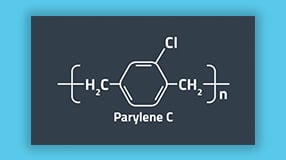
Unlike other variants, Parylene C contains one chlorine atom, Parylene D contains two chlorine atoms, and Parylene F contains four fluorine atoms per repeat unit. Because Parylene N is composed solely of carbon and hydrogen, it offers contains only carbon and hydrogen, it provides exceptional chemical purity and predictable electrical properties.
Molecular Structure Differences
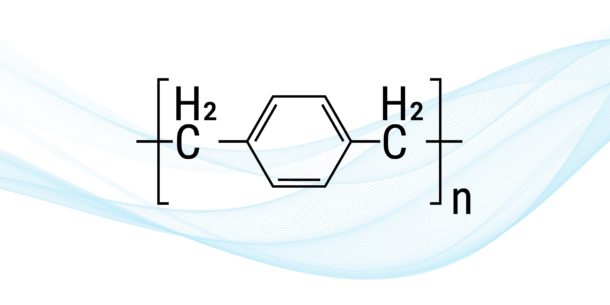 Parylene N chemical structure.
The key difference between Parylene N and other variants lies in molecular substitution. Parylene N uses an unsubstituted aromatic ring, while other variants introduce halogen atoms to alter performance characteristics.
Halogen substitution changes several properties, including barrier performance, thermal stability, electrical properties, and chemical resistance.
Electrical Performance Advantages of Parylene N
One of the most important advantages of Parylene N is its low dielectric constant.
Typical Dielectric Constants (60 Hz)
| Material | Dielectric Constant |
| Parylene N | ~2.65 |
| Parylene C | ~3.15 |
| Parylene F (VT4) | ~3.1 |
Conformality and Penetration
Like all Parylene coatings, Parylene N is deposited through chemical vapor deposition (CVD), producing extremely uniform coatings that conform to complex surfaces.
Parylene N’s polymerization behavior allows it to penetrate extremely small features including microvias, fine-pitch electronics, MEMS structures, and narrow gaps. This feature is known by different names across industries, including “crevice penetration,” “penetration depth,” “throwing distance,” “gap fill,” etc.
Chemical Purity and Halogen-Free Benefits
Because Parylene N contains no chlorine or fluorine atoms, it is considered halogen-free. This characteristic is valuable in applications where chemical purity is critical.
Moisture Barrier Comparison
While Parylene N excels in electrical performance, it is generally not the best Parylene variant for moisture protection. Parylene C is widely recognized for its superior moisture barrier properties. In applications where the presence of halogens may be an issue, Parylene N still offers a good moisture barrier, but may require a greater thickness than that of Parylene C to provide a similar level of moisture protection.
Thermal Performance
Halogen substitution also affects thermal behavior. Parylene N provides moderate thermal stability, while fluorinated Parylene variants offer much higher temperature capability.
When Should You Choose Parylene N?

Parylene N is typically selected when applications require low dielectric constant, stable electrical performance, halogen-free materials, ultra-conformal coatings, high chemical purity, and high lubricity.
When Is Parylene C a Better Choice?
Parylene C is often preferred when moisture protection is critical, chemical barrier performance is needed, or general environmental protection of electronics is required.
COMPARE PARYLENE VARIANTS WITH OUR DATA SHEET
Key Takeaways
Parylene N offers halogen-free chemistry, excellent dielectric performance, and superior penetration into complex geometries. However, it generally provides lower moisture barrier performance than Parylene C.
FAQ
-
Is Parylene N halogen-free? Yes. Parylene N contains only carbon and hydrogen atoms.
-
Does Parylene N have the lowest dielectric constant? Yes, among commonly used Parylene coatings.
-
Is Parylene N better than Parylene C? Not necessarily. Parylene N offers better electrical performance while Parylene C offers stronger moisture barrier protection.
What is Parylene Coating? Uses, Properties, and How to Choose It
Parylene CVD vs. ALD vs. PECVD: Here's What R&D Leaders Should Know
Parylene Conformal Coatings - Parylene Conformality Explained


Learn About the Different Markets We Serve

Learn About HZO Coatings With Our Resource Page
Learn About HZO Parylene With Our Resource Page

Learn About HZO's Partnership With a Fortune 100 Consumer Electronics Company

Learn About HZO's Partnership With PRISMVIEW

Learn About Our Turnkey Coating Solution

Learn How Much HZO Coatings Cost

Learn About HZO Customers

Learn About HZO Awards Won

Overcoming Parylene Coating Challenges Video
How HZO Makes Parylene Scalable

How to Evaluate if Protective Thin-Film Coatings Are Right for Your Business
Learn What It's Like to Work With HZO

Why You Need HZO Protection For Your Electronics
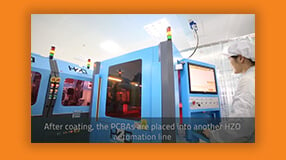
How HZO Integrates Into Your Manufacturing Process